1Independent Researcher2Georgia Institute of Technology3The Hong Kong University of Science and Technology
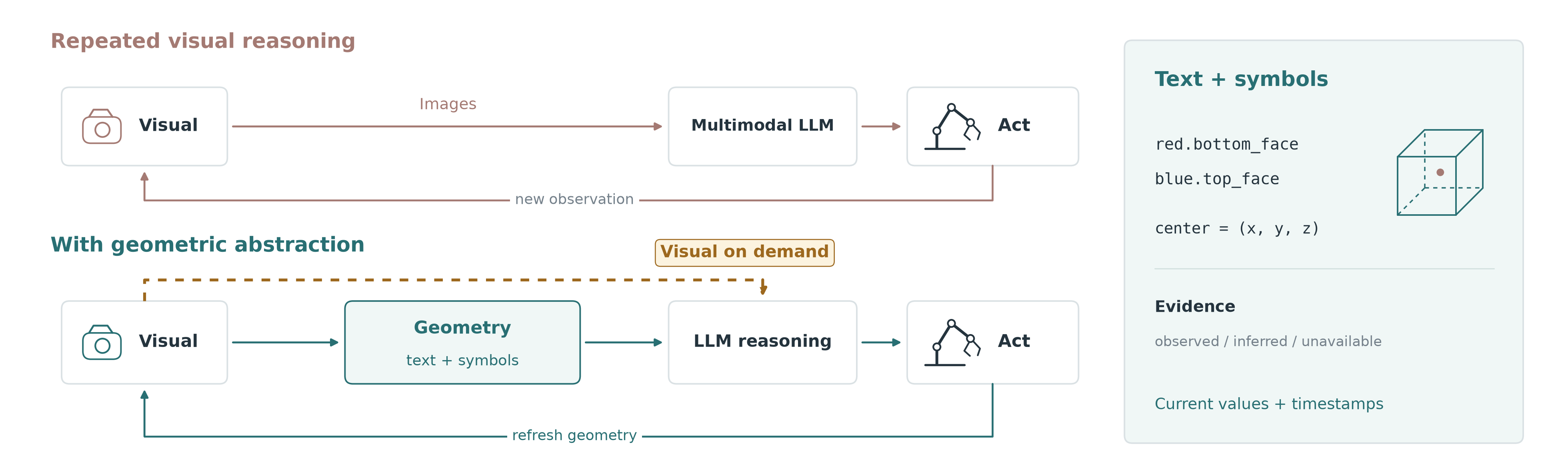
TL;DR Shift routine spatial reasoning from images to text and symbols. A 3D geometric abstraction, refreshed locally from RGB-D, gives LLM agents typed, evidence-aware part references and compact metric checkpoints, improving multi-step manipulation completion while cutting repeated multimodal queries.
Online ring-on-peg, Geometric Abstraction vs. Pixel Reasoning
−33.3%mean completion time
−49.4%model-request time
−52.8%recorded tokens
10.9 → 2.7images sent per episode
Abstract
Recent multimodal language models can reason directly about robot scenes, but it is unclear whether they need to repeatedly reinterpret raw visual observations at every step of an interaction. We propose shifting routine spatial reasoning from images to text and symbols through a 3D geometric abstraction that is refreshed locally from observations and read directly by the language models. Specifically, our interface represents scene geometry via typed, evidence-aware symbolic references to object parts, grounds them from calibrated RGB-D, and returns compact textual checkpoints with metric residuals after each action. Symbolic task structure can thus be reused across decisions while metric values are rebound to the current scene, with direct visual reasoning invoked only on demand. Across offline policy synthesis and continuous online execution, reasoning over grounded text and symbols improves multi-step manipulation completion while substantially reducing repeated multimodal queries, positioning explicit geometric state as an effective substrate for agentic robot policies.
Method
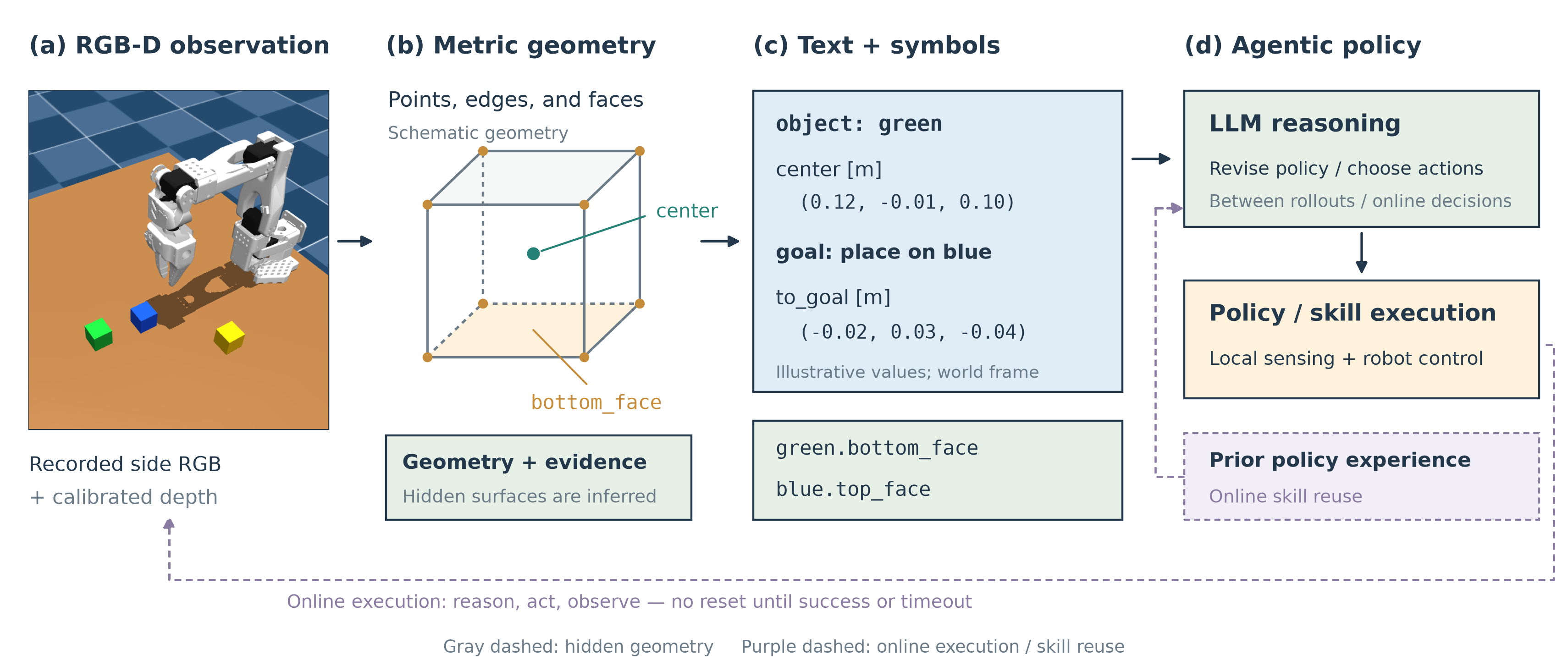
RGB-D observations are grounded into object geometry and exposed to the LLM through typed symbolic references and compact textual checkpoints. In policy synthesis, the LLM revises executable policies between rollouts while perception and control run locally; in online execution, the same interface supplies updated geometry for successive decisions within a continuing episode.
Ground locally
Calibrated side and wrist RGB-D are back-projected into the world frame to estimate each object's center, orientation, dimensions, vertices, edges and faces, each with a timestamp, using lightweight CPU estimators. Shape may persist, but pose must be refreshed: after an object moves, its pose is re-estimated from a current observation, never copied from a commanded motion.
Reference symbolically
Policies refer to typed parts like red.bottom_face and blue.top_face and compose them with operators such as surface alignment and support checks. Every value carries its evidence status: observedinferredunavailable. The same program rebinds to new scenes.
Checkpoint in text
After each action the agent receives a compact checkpoint with the updated 3D coordinates, evidence status and metric residual to the goal. If an object is occluded, the residual is marked unavailable rather than computed from a stale estimate. Images stay available on demand.
Operators on the geometric state
Operation
Inputs
Output
reference
object and role
geometric entity with evidence
relation
predicate and objects
residuals and true/false/unknown
align
source and target geometry
desired rigid transform
checkpoint
active object and goal
compact textual state
Tasks
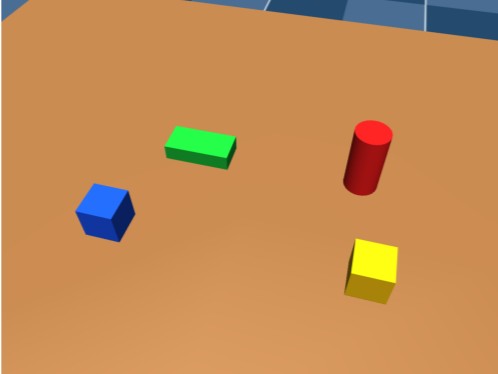
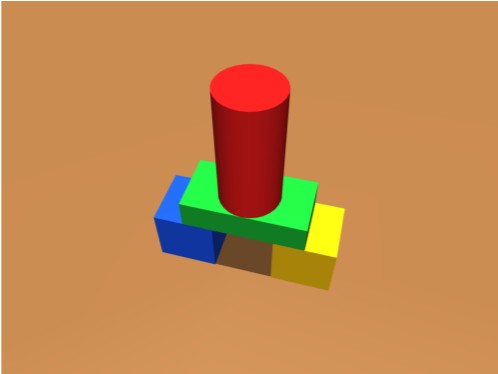
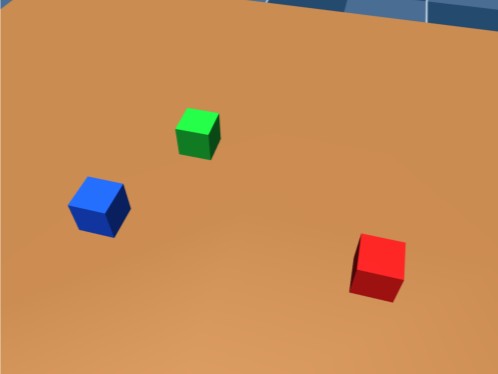
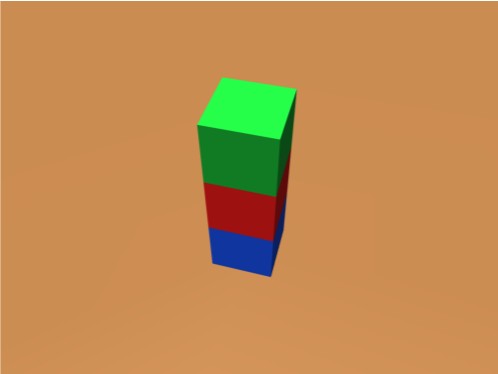
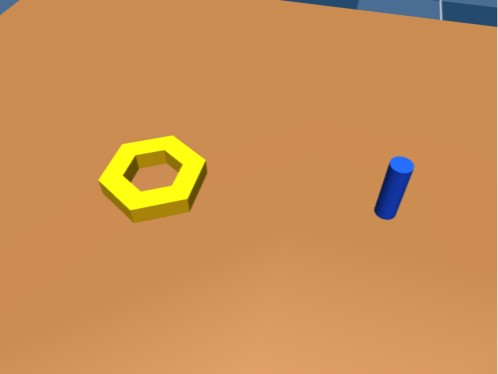
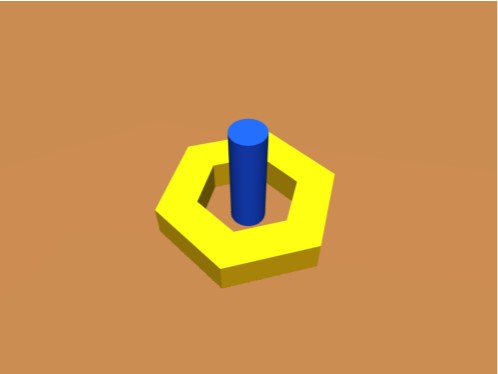
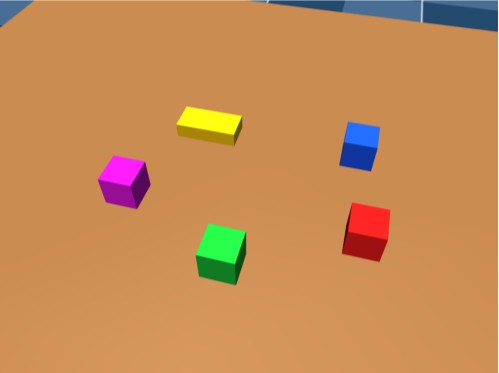
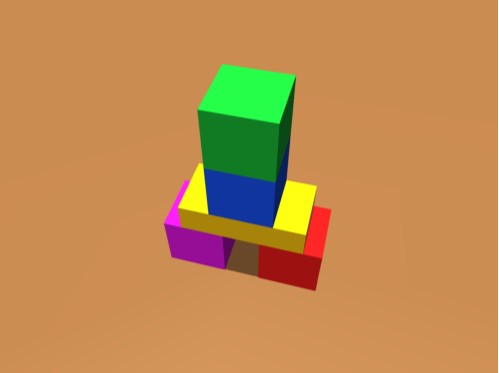
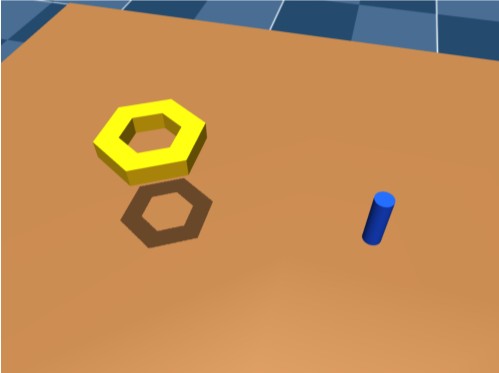
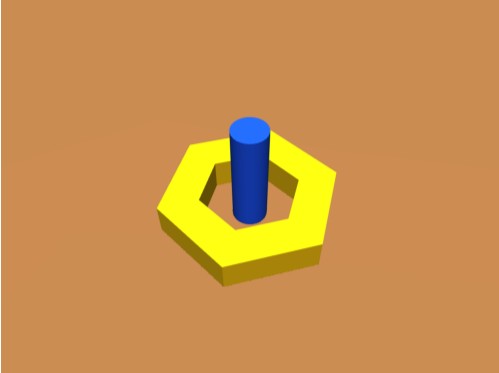
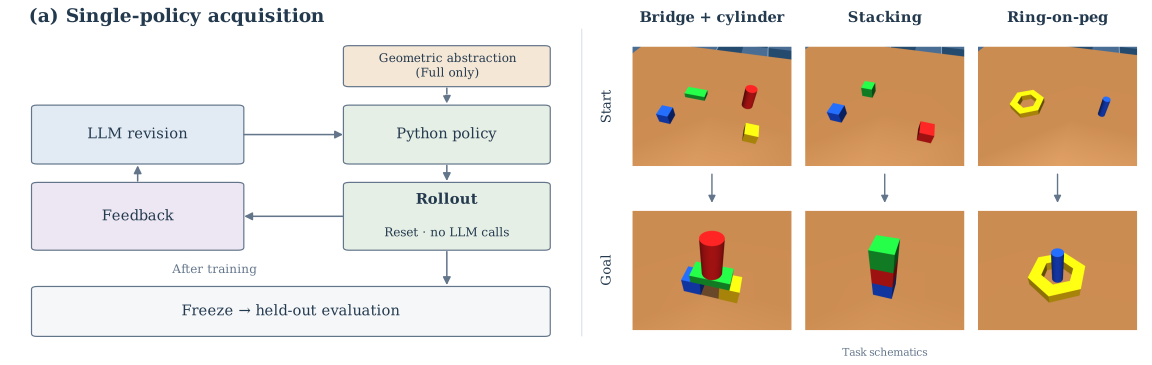
A simulated SO-100 arm builds and inserts with simple rigid objects. Each card shows a start and goal configuration. These are constructed renderings, not recorded policy trajectories.
Single-policy acquisition
→
Bridge + cylinderPlace two base blocks, span them with a beam, and stand a cylinder on top.
→
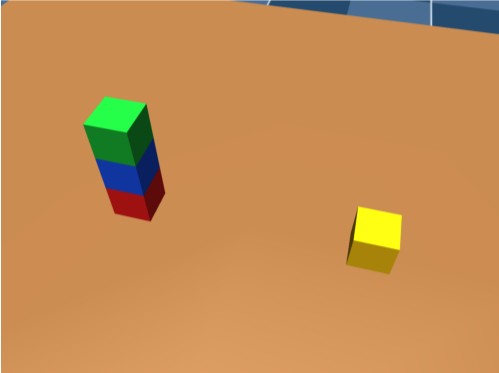
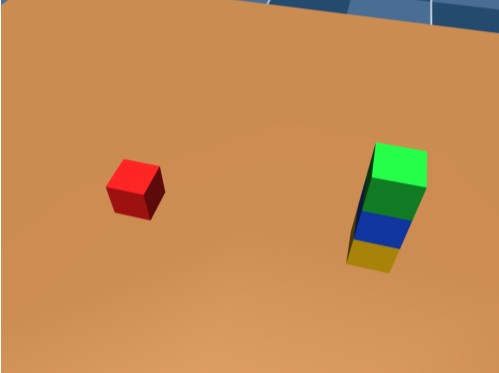
Three-cube stackingBuild a three-cube tower in a prescribed color order.
→
Ring-on-pegGrasp a hexagonal ring and thread it onto a vertical peg.
Continuous online execution
→
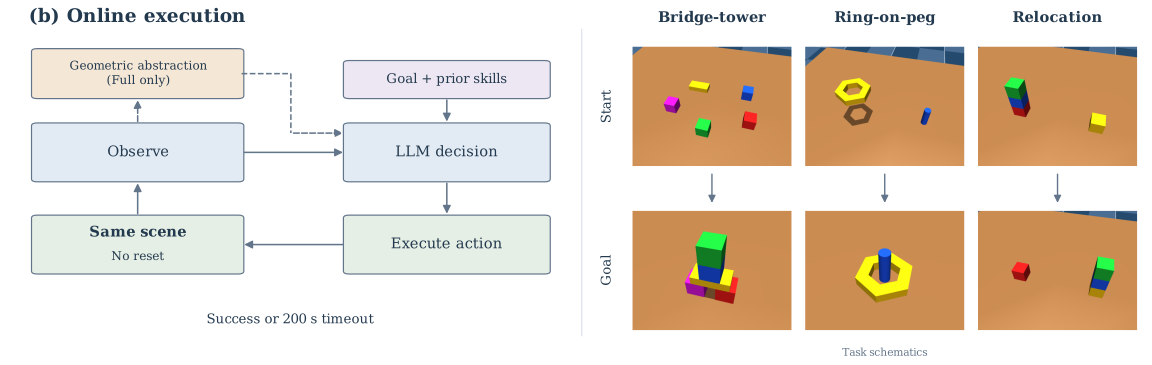
Bridge-towerBuild a bridge, then stack two cubes on the beam.
→
Ring-on-peg (after shared lift)Align a pre-lifted ring over the peg and release it.
→
Tower relocationMove the upper two cubes of a column onto a new foundation, keeping their order and both foundations in place.
Experiments
A simulated SO-100 arm with calibrated side and wrist RGB-D cameras. We compare a Pixel Reasoning agent that reasons directly from visual observations with a Geometric Abstraction agent that additionally receives our grounded geometric references and textual checkpoints. Both share the task specification, sensor access, actuator interface and initial skills; neither ever sees simulator object poses or private evaluator state.
1 Single-policy acquisition
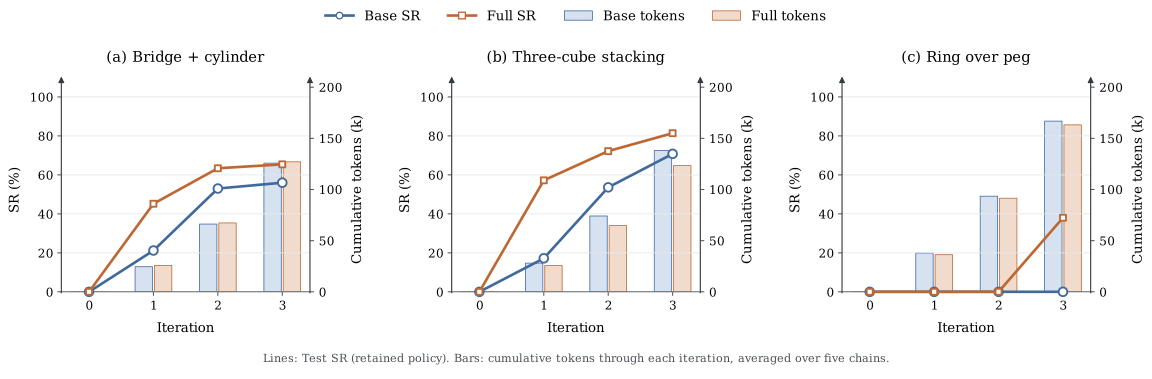
The LLM (gpt-6-astra, high reasoning effort) revises an executable Python policy between reset rollouts: an observation-only scaffold (R0), then three revisions (R1–R3), with no LLM calls during execution. Five paired chains per task train on five shared layouts; a revision is kept only if it solves every previously solved layout plus one more. After training freezes, every retained version is tested on 100 shared held-out layouts.
Geometric abstraction substantially accelerates policy acquisition. At R1 it reaches 45.2% held-out success on Bridge + cylinder (vs. 21.2%) and 57.2% on stacking (vs. 17.2%). By R2 it already surpasses Pixel Reasoning’s final R3 on both tasks with roughly half the cumulative tokens (67.3k vs. 125.7k; 64.7k vs. 138.1k). On Ring-on-peg, only Geometric Abstraction acquires a working policy within budget (38.0% vs. 0.0% at R3).
2 Continuous online execution
The LLM (gpt-6-astra, medium reasoning effort) orchestrates shared prior skills in one continuing scene until it succeeds or hits a 200 s wall-clock budget. Failed actions are not reset, and physics keeps running while the model thinks, so waiting costs the same budget as acting. Both agents can request images and depth samples on demand. We evaluate 50 paired layouts per task (300 episodes).
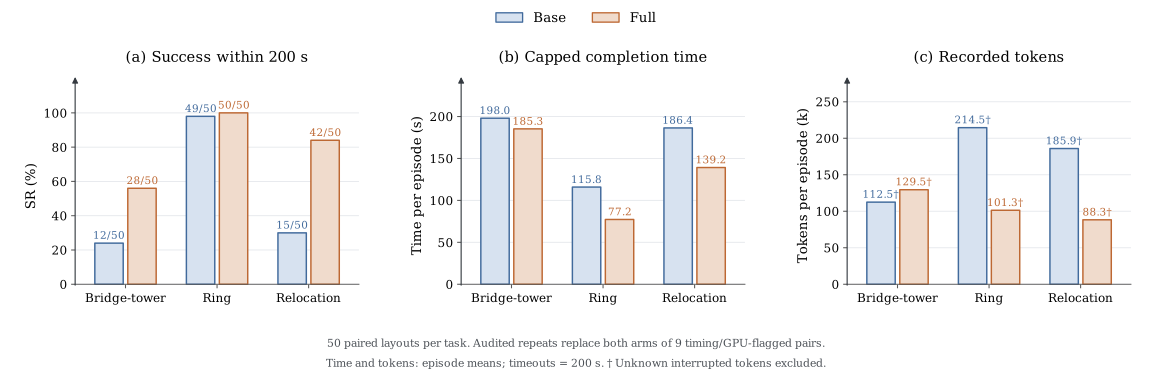
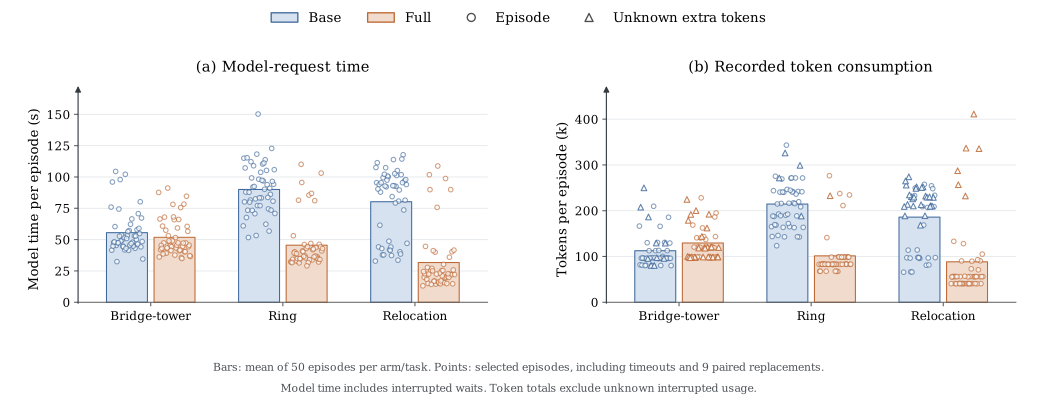
Geometric Abstraction solves Bridge-tower on 28/50 layouts (56% vs. 24%) and Tower relocation on 42/50 (84% vs. 30%), with lower mean completion times. On Ring-on-peg, where both reliably succeed (50/50 vs. 49/50), it finishes 33.3% faster (77.2 s vs. 115.8 s), earlier on 45 of 50 pairs.Model interaction cost per episode. On Ring-on-peg, model-request time drops 49.4% and recorded tokens 52.8%; on Tower relocation, 60.5% and 52.5%, with similar physical execution time. On Bridge-tower, Geometric Abstraction more than doubles completion with 6.7% less model time and 15.1% more tokens.
Inside an average tower-relocation episode
LLM request with imageLLM request, text only
Pixel Reasoning
186.4 s11.6 req · 11.3 img
Geometric Abstraction
139.2 s5.4 req · 3.0 img
0 s50 s100 s150 s200 s
Each line ends at mean capped completion time (timeouts = 200 s); requests are rounded and evenly spaced from the start of the episode for illustration. Means over 50 episodes per agent.
Online outcomes and cost over 50 paired layouts per task (means per episode; timeouts count as 200 s)
Task
Agent
Success
Time (s)
Model (s)
Tokens (k)
Requests
Images
Bridge-tower
Pixel Reasoning
12/50
198.0
55.5
112.5
7.88
7.50
Geometric Abstraction
28/50
185.3
51.8
129.5
7.32
4.28
Ring-on-peg
Pixel Reasoning
49/50
115.8
90.0
214.5
11.88
10.94
Geometric Abstraction
50/50
77.2
45.6
101.3
6.90
2.72
Tower relocation
Pixel Reasoning
15/50
186.4
80.3
185.9
11.58
11.34
Geometric Abstraction
42/50
139.2
31.7
88.3
5.36
3.00
Rollouts
Continuous demo rollouts of each task in the same simulated SO-100 setup, recorded for this page. They show the physical tasks, not the study's LLM agents: single-policy tasks use hand-written controllers from the repository, and the online tasks use scripted controllers. The result tables above report the actual study episodes. Sparse replays of real study episodes are in the code repository.
Single-policy tasks
Bridge + cylinder · 3× speedThree-cube stacking · 3× speedRing-on-peg · real time
Simulation only, so far. We evaluate simulated table-top manipulation with regular object geometries. Real-world deployment is the essential next step, to test robustness to sensor noise, heavy occlusion and camera calibration drift.
Lightweight perception by design. CPU geometric estimators keep local grounding fast and self-contained; learned 3D perception and articulated or deformable objects are left for future work.
Actionable state, not just shorter prompts. Online, geometric abstraction reduced decision rounds and image attachments across tasks. Its main benefit is direct, actionable spatial state throughout the reasoning–action loop. More concise checkpoints and learned symbolic abstractions could cut overhead further, and VLM-assisted shape initialization could cover novel objects if its one-time cost is amortized.
Toward text-only robot reasoning. Decoupling local visual grounding from high-level reasoning opens the door to fast text-only language models, and to evaluating spatial reasoning on standardized geometric checkpoints.
Citation
@inproceedings{liu2026geometric,
  title     = {Do Agentic Policies Need to Look at Every Step? Geometric Abstraction for Reasoning and Action},
  author    = {Liu, Yihang and Chen, Yiming and Zheng, Mingzhe},
  booktitle = {CoRL 2026 Workshop on Agentic Robotics},
  year      = {2026}
}